
Is Infectious Disease Research in Africa “Subcontracted”? Nagasaki University Quantifies "Research Inequality" to Bolster Pandemic Preparedness
A research group led by Associate Professor Tamaki Raita at the Institute of Tropical Medicine, Nagasaki University (NEKKEN), has investigated the reality of infectious disease research in Sub-Saharan Africa*. The study provides data-driven evidence that despite high disease risks, local research capacity remains significantly low, and heavy dependence on external donors from developed nations is stripping local institutions of “research leadership.”
This study is the first in the world to quantitatively demonstrate the structure of research leadership by operationalizing the concept of “decolonising research” (shifting toward locally led research), which has previously been discussed only conceptually. It highlights that transforming research systems so that African researchers lead their ownerhip is essential to preventing future pandemics at their source.
*Sub-Saharan Africa: the region of the African continent located south of the Sahara Desert.
Visualizing the “inconvenient truth” of research inequality
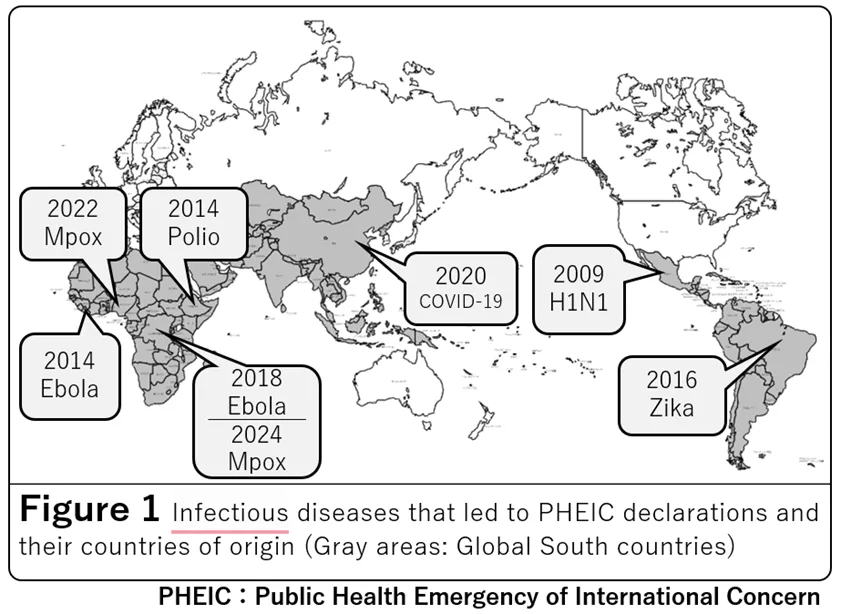
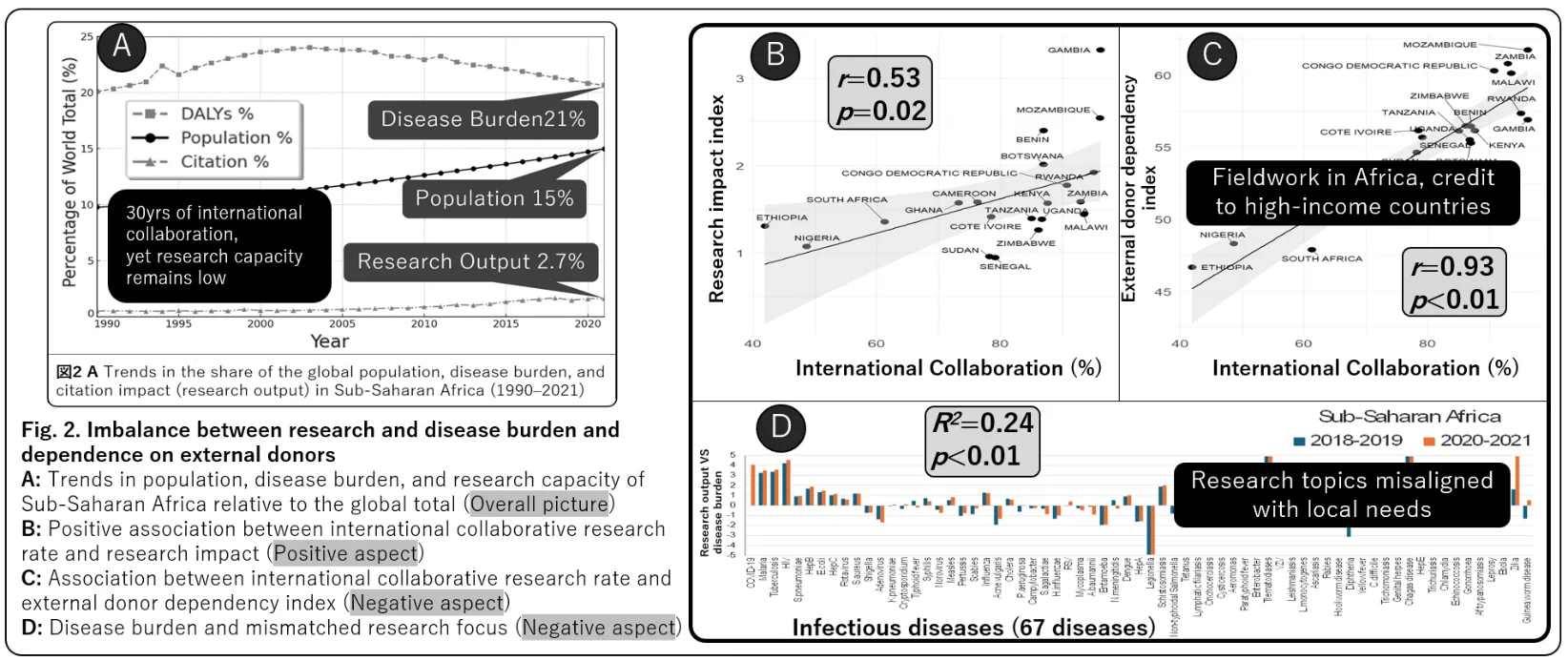
Sub-Saharan Africa, a hotspot for emerging and re-emerging infectious diseases with pandemic potential (Fig.1), accounts for 15% of the global population and 21% of the global disease burden. However, its research output is only 2.7%. Despite decades of external donor investment, structural disparities in research capacity have shown little improvement over the past 30 years (Fig. 2A).
The Pitfalls of External Dependency
The “he who pays the piper calls the tune” dynamic is evident. The study shows that the more research relies on external funding, the more it is shaped by donor priorities rather than local needs (disease burden), creating a distortion in research agendas (Fig. 2D).
From “data collectors” to leaders
The study quantitatively demonstrates a hierarchical structure in which local researchers conduct fieldwork while researchers in high-income countries lead manuscript writing. A new evaluation indicator is proposed to address this imbalance (Fig. 2C).
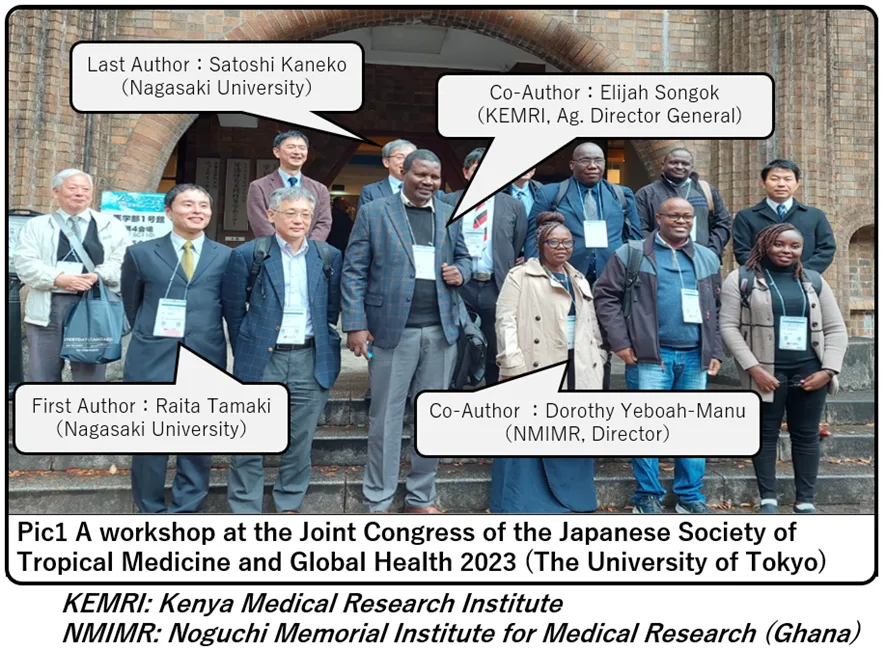
This study originated from field observations made by Associate Professor Tamaki during his deployment to a JICA technical cooperation project in Kenya*, under a comprehensive partnership agreement between JICA and Nagasaki University. Through discussions with directors of major research institutes in Kenya and Ghana (co-authors) at the 2023 Annual Meeting of the Japanese Society of Tropical Medicine (Pic.1), and following a presentation at TICAD 9 (Yokohama, 2025), the study was published in the international journal BMJ Global Health.
*Project for Strengthening Research Capacity at the Kenya Medical Research Institute (JICA):
https://www.jica.go.jp/oda/project/202107657/index.html
https://www.jica.go.jp/oda/project/202107657/index.html?wovn=en (auto-translation)
Strengthening global epidemic preparedness
Building autonomous research ecosystems led by local researchers in high-risk countries will enable early detection and containment of emerging infectious diseases, preventing pandemics.
Advancing the decolonisation of research
The study provides a pathway to correct the “subcontracting structure” driven by external funding and to promote fair and sustainable research investment aligned with local disease burdens.
Paradigm shift in international collaboration
It proposes a new evaluation framework that prioritizes leadership and career development of local researchers, moving beyond traditional models that rely on local actors mainly for data collection.
Development of next-generation models
Through a newly funded JSPS KAKENHI, this research will be expanded to the Global South (Fig.1) to propose a new international research ecosystem in which countries at risk of pandemics can lead research independently.
Policy implementation
The findings will be disseminated at international policy platforms such as TICAD to promote concrete reforms in research funding allocation and human resource development.
This research was supported by:
JICA Technical Cooperation Project
Japan Society for the Promotion of Science (JSPS)
Japan Agency for Medical Research and Development (AMED) / SCARDA (Program for World-Leading Research and Development Centers for Vaccine Development)
Japan Agency for Medical Research and Development (AMED)
Journal: BMJ Global Health
Title: Research capacity and decolonisation in Sub-Saharan Africa: a bibliometric analysis
Authors: Raita Tamaki, Yuki Furuse, Hirotake Mori, Kazuki Santa, Kazuki Shimizu, Hongxiang Wang, Kozo Watanabe, Ryo Komorizono, Samson Muuo Nzou, Evans Inyangla Amukoye, Elijah Maritim Songok, Dorothy Yeboah-Manu, Shingo Inoue, Satoshi Kaneko
URL: https://gh.bmj.com/content/11/3/e021609
For more details, please refer to the full article published in BMJ Global Health.


