
Redescription of Hemitrygon akajei with description of the cryptic stingray species Hemitrygon ariakensis sp. nov. from the Northwest Pacific (Myliobatoidei: Dasyatidae)
A research team led by Professor Atsuko Yamaguchi and Researcher Keisuke Furumitsu at the Faculty of Fisheries, Nagasaki University, has revealed that Hemitrygon akajei, long considered one of the most familiar rays along the Japanese coast, actually consists of multiple species that were mistakenly treated as a single species for over 160 years.
This study redescribes Hemitrygon akajei (red stingray) and describes a cryptic species, Hemitrygon ariakensis, as a new species first identified in the Ariake Bay.
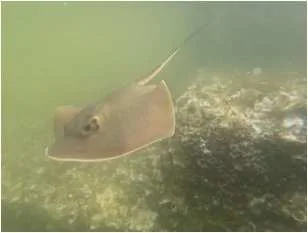
The Hemitrygon akajei stingray commonly found along the coast of Japan
We redescribe Hemitrygon akajei (Bürger in Müller and Henle 1841) based on the lectotype and newly collected specimens, and describe Hemitrygon ariakensis sp. nov. from western Japan. Owing to their considerable morphological similarity and sympatric distribution, these two species have been subject to longstanding taxonomic confusion, with one remaining unrecognized as a cryptic species for over 160 years prior to the availability of molecular evidence. The red stingray H. akajei was originally described from six syntypes, including juveniles that represented multiple species, including the cryptic one. Species identification in Hemitrygon is complicated not only by interspecific morphological resemblance but also by marked ontogenetic changes between juveniles and adults. Herein, we describe the external morphology of both species across developmental stages to aid in their distinction. Hemitrygon akajei and H. ariakensis sp. nov. can be distinguished by the following combination of characters: arrangement of denticles on dorsal surface of disc and posterior part of tail; shape, size, and arrangement of thorns on dorsal tail anterior to caudal spine; presence or absence of transverse groove on ventral surface of disc; coloration of ventral tail fold; shape of outer marginal color band on ventral disc; morphology of clasper and prepelvic processes of pelvic girdle; and number of prespine separate centra. Stingrays are important fishery resources and key mesopredators in Japanese coastal ecosystems, influencing populations of other fishery species. The ability to distinguish these two species will facilitate more accurate ecological research, enable the development of species-specific conservation strategies, and promote effective biodiversity management. Such taxonomic resolution is essential for understanding coastal ecosystem dynamics.
Journal: Ichthyological Research
Title: Redescription of Hemitrygon akajei with description of the cryptic stingray species Hemitrygon ariakensis sp. nov. from the Northwest Pacific (Myliobatoidei: Dasyatidae)
Authors: Keisuke Furumitsu, Atsuko Yamaguchi
DOI: 10.1007/s10228-025-01048-5
For more details, please refer to the full article published in Ichthyological Research.


