
A different world: temporal changes in the community structure of sea slugs (Heterobranchia) in northwest Japan spanning more than a half-century
Riko Kato, a master’s student in the Graduate School of Integrated Science and Technology (Fisheries Sciences), and Associate Professor Mitsuharu Yagi of the Faculty of Fisheries conducted a comparative analysis of changes in the nudibranch fauna (a group of gastropod mollusks) inhabiting the southwestern coastal waters of Nagasaki Prefecture over the past 50 years. Their study is the first in Japan to clearly demonstrate that climate change–driven alterations in the marine environment are distinctly reflected in local nudibranch communities.
The research integrated historical records from the 1960s to 1980s, survey data from 2001 to 2003, and data from 27 scuba-diving surveys conducted in 2023–2024 (Photo 1) to examine long-term changes in biodiversity in the same coastal area. The results revealed that nudibranch species characteristic of cool-temperate to subarctic regions, once commonly observed, have nearly disappeared. In contrast, the proportion of tropical to subtropical species has increased markedly.
In particular, in the most recent surveys (2023–2024), 55.3% of the 47 recorded species were classified as tropical to subtropical, representing a substantial rise compared with 20 years ago (42.9%). Meanwhile, subarctic and cold-water species documented 50 and 20 years ago are no longer present. Ecological data thus substantiate a clear “southernization” of the local marine fauna. These changes are consistent with the rising trend in sea surface temperature anomalies and represent an important case illustrating the impacts of climate change on coastal ecosystems.
This study was supported by the 2024 Sasakawa Scientific Research Grant from The Japan Science Society, and the findings were published in the international academic journal PeerJ on March 3, 2026.
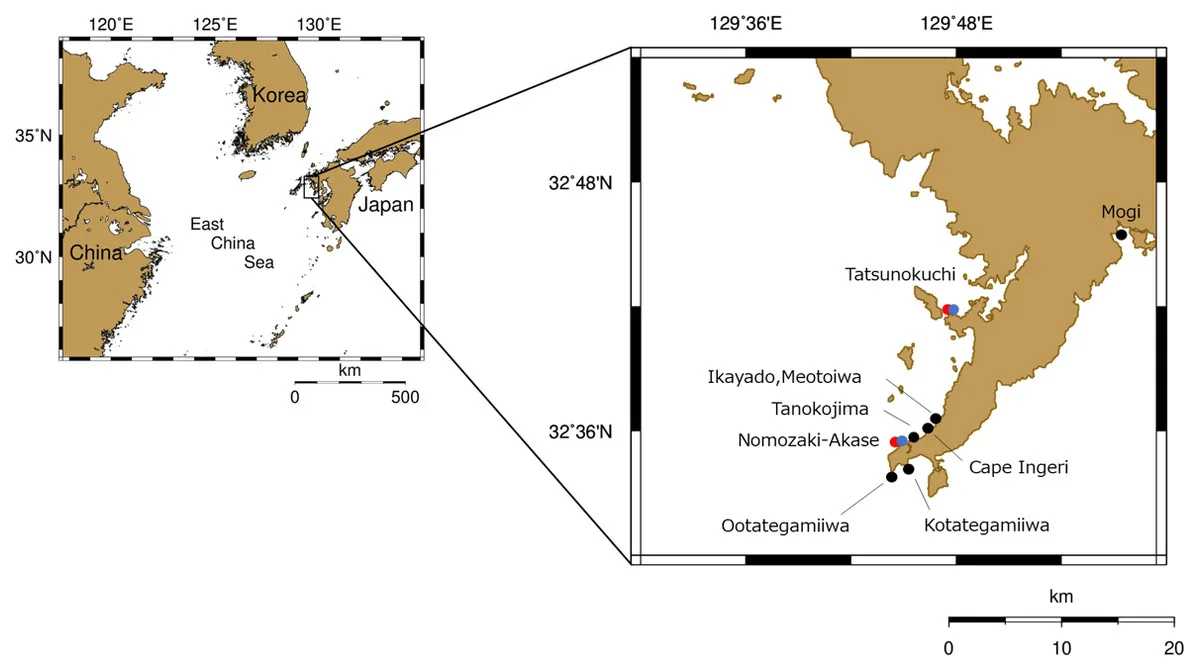
Figure 1: Survey sites of heterobranch sea slug assemblages.
Black dots indicate sites surveyed by Matsubayashi (1989). Blue dots indicate sites surveyed by Kawahara (2003), and red dots indicate sites surveyed in the present study.
Understanding long-term changes in marine biodiversity is essential for evaluating effects of climate change on coastal ecosystems. In this study, we compared heterobranch sea slug (hereafter referred to simply as ‘sea slugs’) assemblages in northwestern Kyushu, Japan, across three survey periods: (1) historical records from 1960–1980, for which the exact survey effort and duration were not documented; (2) surveys conducted from April 2001 to September 2003; and (3) recent surveys conducted from June 2023 to January 2024. A total of 47 sea slug species were recorded from our underwater surveys conducted in 2023–2024. Species diversity indices, including the Shannon–Wiener diversity index (H) and Simpson’s diversity index (D), showed higher values during this survey than those of 2001–2003. Comparative analysis of species composition revealed significant shifts, with 15 species exhibiting statistically significant differences in relative abundance from the past to the present. Notably, several species common in the past, such as Aplysia kurodai, were rarely observed in the recent survey, while many tropical–subtropical species appeared for the first time. The proportion of tropical–subtropical species increased markedly, whereas subarctic species were no longer detected. Jaccard’s coefficient indicated that the current community differs markedly from those in earlier periods. These findings suggest a major community reorganization, potentially driven by rising seawater temperatures and other environmental changes. This study highlights the importance of long-term monitoring using multiple indicators to detect and interpret climate-driven biodiversity shifts in coastal marine ecosystems.
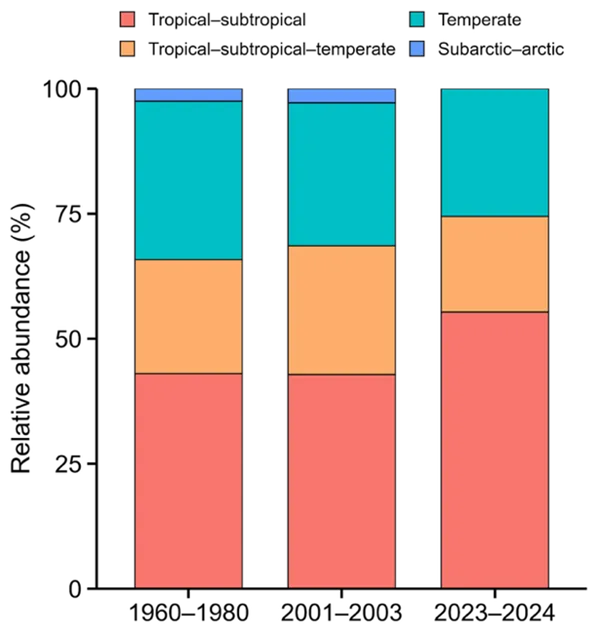
Figure 2: Comparison of climatic preferences of observed heterobranch sea slug species during different survey periods.
In the most recent period, species belonging to the subarctic–arctic group were no longer detected, while the proportion of tropical–subtropical species increased. All surveys were conducted along the northwestern coast of Kyushu, Japan.
Journal: PeerJ
Title: A different world: temporal changes in the community structure of sea slugs (Heterobranchia) in northwest Japan spanning more than a half-century
Authors: Riko Kato, Mitsuharu Yagi
DOI: 10.7717/peerj.20870
For more details, please refer to the full article published in PeerJ.
Fisheries Environmental Science Lab HP: https://sites.google.com/view/yagi-lab/news


