
Efficacy of removing marine debris and the effects of sustained exposure on a Zostera marina meadow
A research group led by Alifro Maldini (first-year doctoral student) of the Graduate School of Integrated Science and Technology, Professor Gregory N. Nishihara (Naoki Nishihara) of the Organization for Marine Science and Technology, conducted a four-year field experiment (2021–2024) in Arikawa Bay, Shinkamigoto Town, Nagasaki Prefecture, to investigate the impacts of seafloor debris on seagrass (eelgrass) meadows and the effectiveness of debris removal.
The results demonstrated that continuous removal of seafloor debris significantly contributed to the recovery of the seagrass meadow area and coverage. In contrast, debris left in place was shown to cause a dramatic decline in seagrass shoot density within just a few months. These findings provide important evidence that seafloor debris removal is an effective approach for ecosystem restoration and for mitigating isoyake (coastal barren ground). Moreover, this study is the first in the world to demonstrate the effects of marine debris on seagrass meadows under natural environmental conditions.
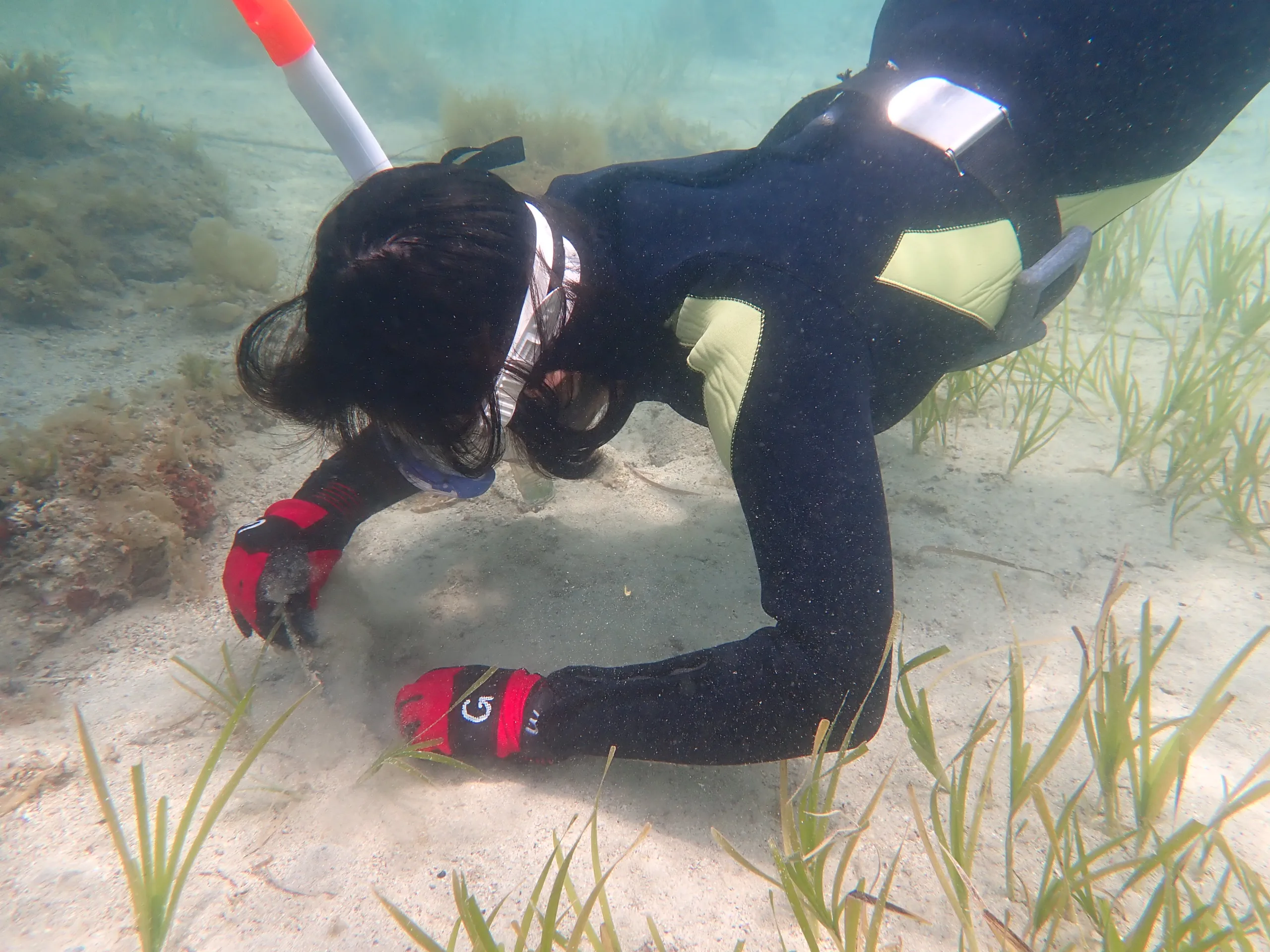
Taken on May 20, 2024, in Arikawa Bay, Nagasaki, Japan. Our team is conducting in situ samplings to retrieve marine debris in the eelgrass bed in both the eelgrass canopy and the sediment that is adjacent to the eelgrass. This effort is important because eelgrass expansion depends on the elongation of its rhizome. Therefore, the existence of marine debris around the eelgrass area potentially blocks the lateral expansion of the meadow.
Marine debris is an environmental pollutant that can lead to the degradation of seagrass meadows. Two field experiments were run to examine the impact of marine debris on the coverage and area of a Zostera marina meadow in Arikawa Bay, Nagasaki, Japan. Experiment 1, which was run from May 2021 to November 2024, demonstrates how marine debris removal affected coverage and area. Experiment 2, which was run from March 2024 to January 2025, demonstrates the effect of marine debris (i.e., fishing nets) emplacement on seagrass shoot density. Due to the nature of experiment 1, a mean normalized difference index (NDI) was used to evaluate the effects of marine debris removal (where high values indicate relatively greater positive effects). The NDI of coverage and area in the section where marine debris removal ceased was 0.189 and 0.263, respectively. Whereas the NDI of coverage and area where marine debris was continuously removed was 0.230 and 0.287, respectively. In experiment 2, shoot density fluctuated naturally with a mean rate of −0.004 ind. m−2 d−1 when marine debris was absent. However, prolonged exposure to debris (67 to 252 days) led to a mean rate of shoot loss that decreased from −0.045 to −0.108 ind. m−2 d−1. In conclusion, we demonstrate that marine debris accumulation in seagrass beds affects the quantity of seagrass and that removal of marine debris can contribute to seagrass restoration. Finally, removing the historical load of marine debris appeared to have led to a natural recovery in this ecosystem.
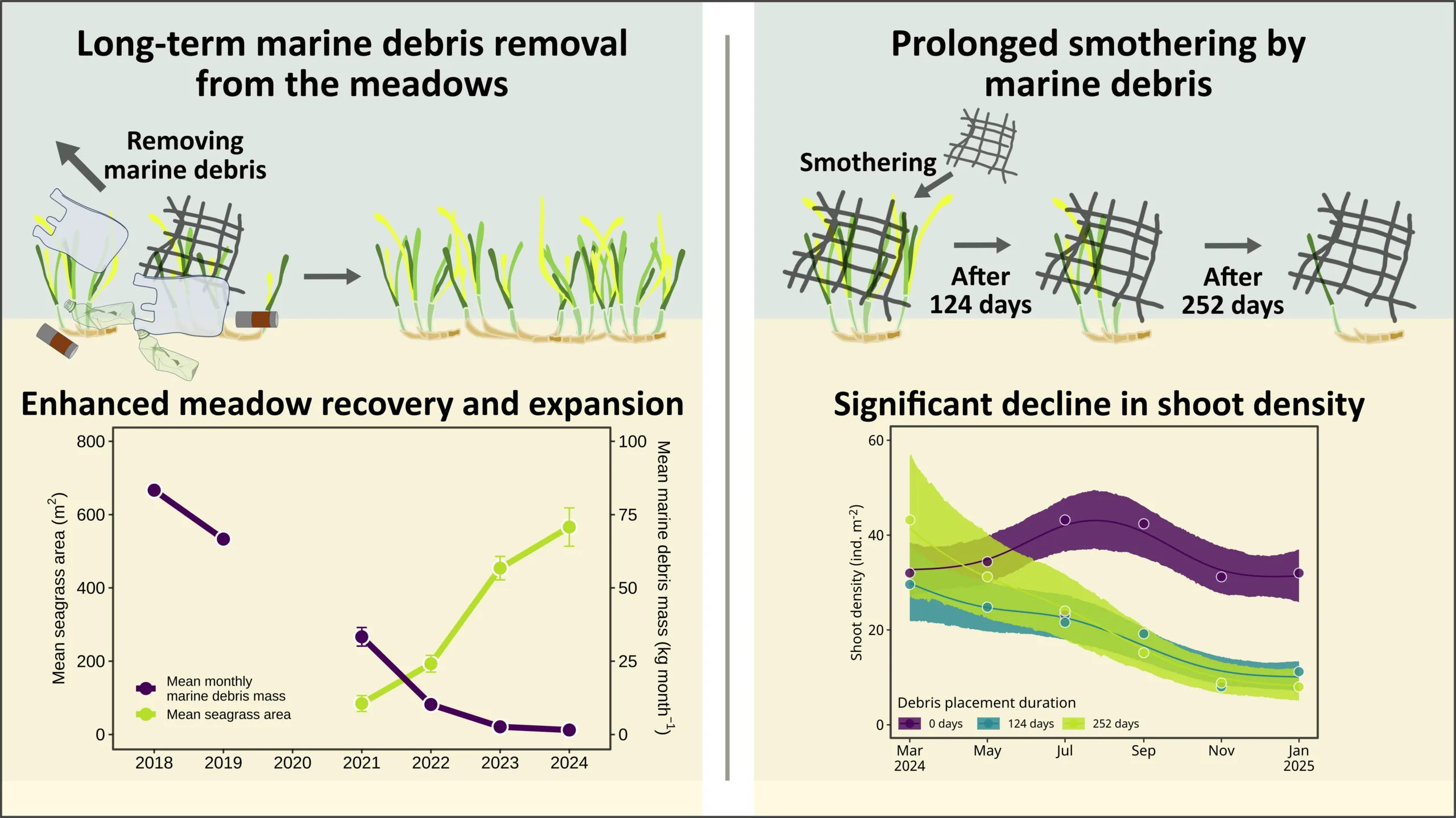
Graphical Abstract

Taken on May 20, 2024, in Arikawa Bay, Nagasaki, Japan. A team member handed a plastic garbage material that was almost completely buried under the sediment. The discovery was striking as an eelgrass plant was found physically attached to this plasticplastic as it was pulled from the seafloor. For analysis purposes, the team used color-coded nets green (for the garbage that is found inside the eelgrass meadow) and red (for the garbage that is found in the surrounding sand) to temporarily store the marine debris during the fieldwork.
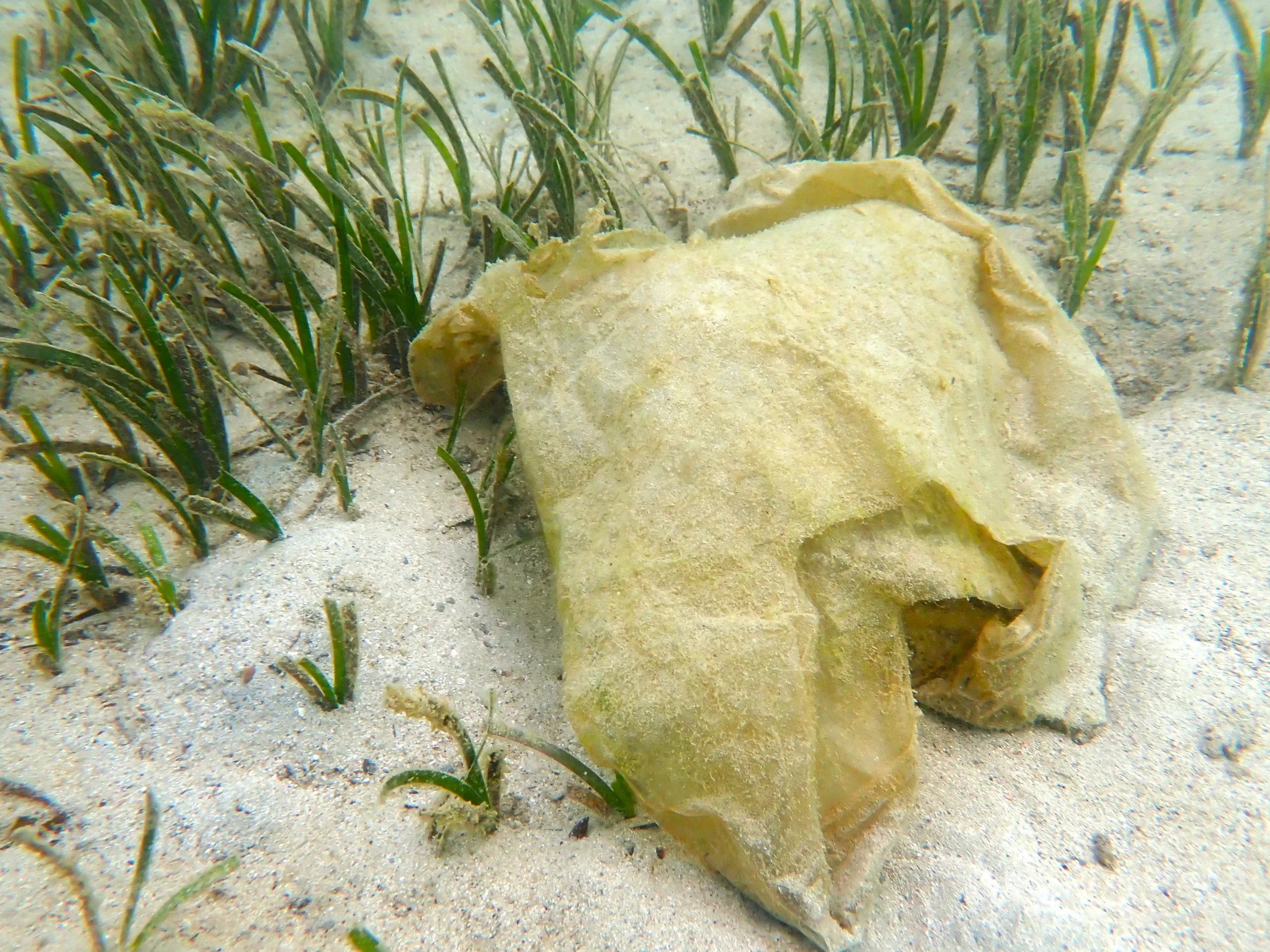
Observed on October 14, 2024, in Arikawa Bay, Nagasaki, Japan. A plastic debris (plastic bag) was found in the eelgrass bed. This specific plastic bag is white as an original color. However, the color shifted to yellow and green due to biofouling that covered up the plastic surface. Under this condition, a plastic bag that is settled within the eelgrass canopy could block the sunlight availability, which will eventually affect the ability of eelgrass to grow.
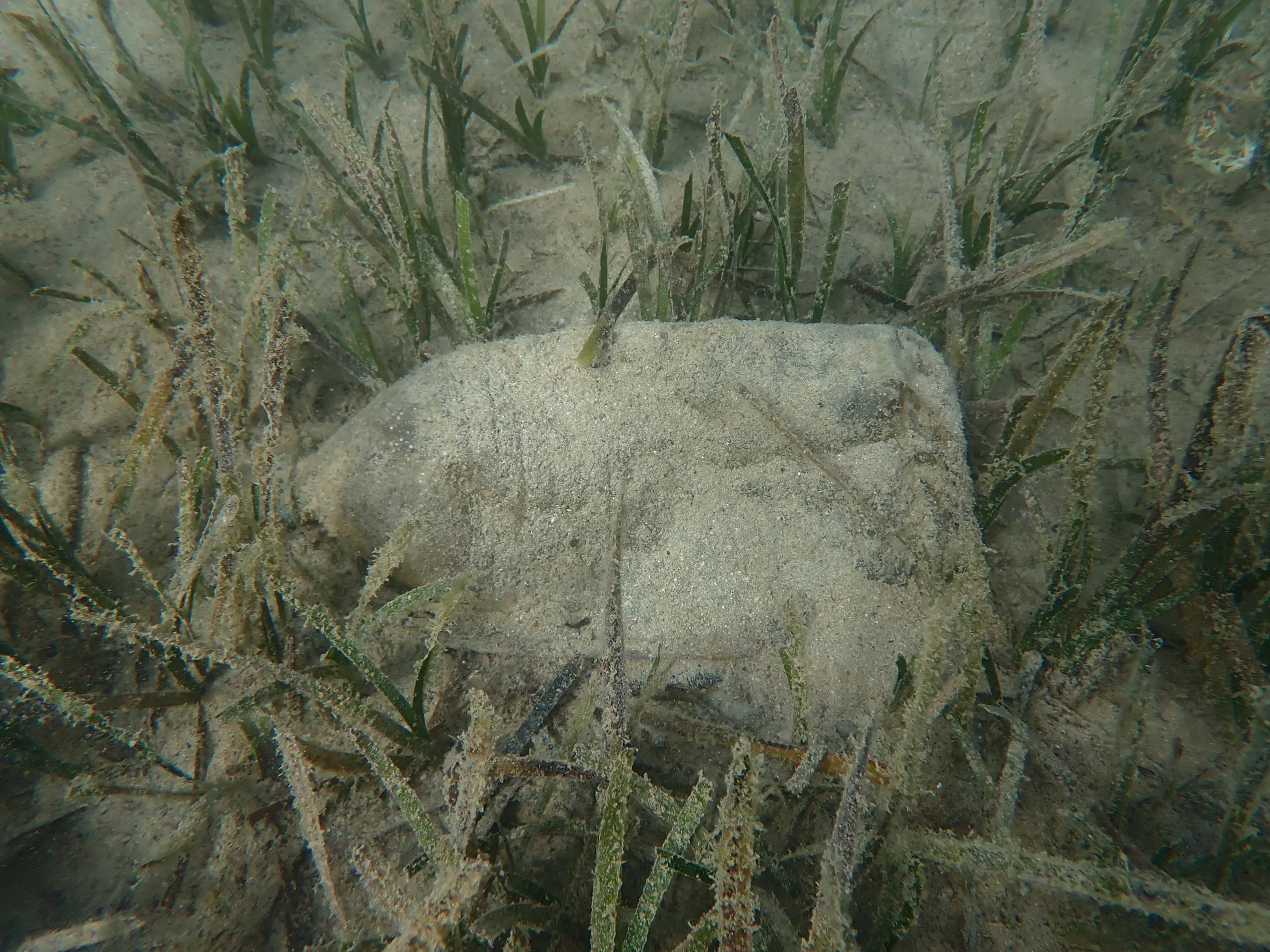
Observed on September 19, 2024, in Arikawa Bay, Nagasaki, Japan. A plastic debris (PET bottle) was found in the eelgrass bed during a period of eelgrass seasonal decline (August – September). Although the meadow density is naturally decreasing in this period, the presence of plastic bottles, such as shown in this photo, creates exerts additional mechanical stress and causes damage to the remaining blades. This condition may exacerbate the meadow during its transition period.
Journal: Marine Pollution Bulletin (2026) 225, 119214
Title: Efficacy of removing marine debris and the effects of sustained exposure on a Zostera marina meadow
Authors: Alifro Maldini, Makoto Kabeyama, Taishun Kobayashi, Tomoyuki Aota, Hikaru Ansai, Nozomu Takashima, Yoshiki Matsushita, Gregory N. Nishihara
DOI: 10.1016/j.marpolbul.2026.119214
For more details, please refer to the full article published in Marine Pollution Bulletin (2026) 225, 119214.


