
Trophic transfer of nanoplastics reduces larval survival of marine fish more than waterborne exposure
A research team led by Siti Syazwani Azmi, a doctoral student at the Graduate School of Fisheries and Environmental Science at Nagasaki University, and Associate Professor Mitsuharu Yagi from the Fisheries Bioresources Program at the Graduate School of Integrated Science and Technology at Nagasaki University, experimentally investigated how microplastics (MPs) and nanoplastics (NPs), which are widely distributed in the ocean, affect the early survival of marine fish, specifically red sea bream (Pagrus major), focusing on differences in ingestion pathways.
Using larvae of Pagrus major as a model, the study demonstrated that survival rates were significantly reduced in larvae ingesting NPs, with the lowest survival observed when NPs were ingested indirectly through zooplankton prey. This adverse effect was more pronounced than when NPs were directly ingested from the surrounding water.
In addition, strong stress responses were detected at the cellular level, including increased activity of antioxidant enzymes and activation of inflammatory genes. These findings indicate that not only the size of plastic particles, micro or nano, but also the route of exposure, direct ingestion or prey-mediated ingestion, plays a critical role in determining the severity of their biological impacts.
This research was supported by the Environmental Research and Technology Development Fund (JPMEERF2022004) of the Environmental Restoration and Conservation Agency, provided by the Ministry of Environment of Japan.
This finding has been published in the international academic journal Science of the Total Environment on December 17, 2025.
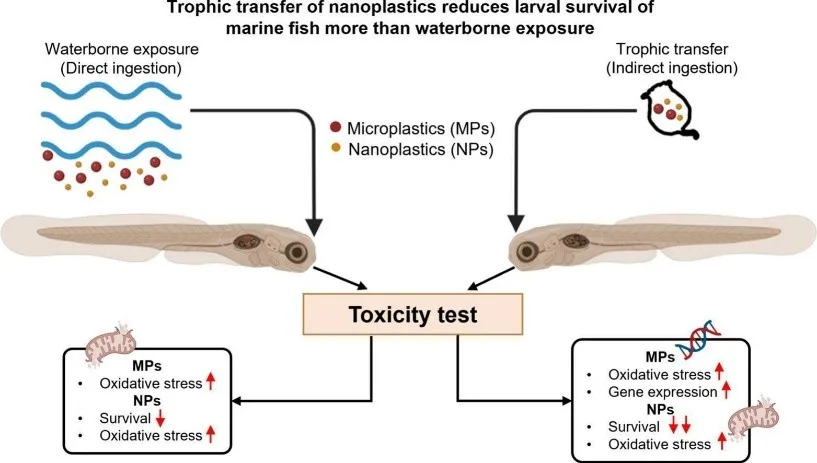
Graphical abstract

Fig. 2. Box-and-whisker plots of the survival rate of red sea bream larvae for 12 days.
Asterisks indicate significant differences (*p < 0.05 and **p < 0.01) by the Tukey post-hoc test,
while grey dots indicate individual replicates (n = 3) for each treatment.
Microplastics (MPs) and nanoplastics (NPs) are widespread contaminants in marine environments and pose significant risks to aquatic organisms. However, physiological effects and survival consequences of different MP and NP exposure pathways during early developmental stages of marine fish remain poorly understood. We investigated effects of direct and indirect consumption of MPs and NPs by larvae of red sea bream (Pagrus major) using a controlled laboratory system. Larvae were exposed to fluorescently labeled polystyrene particles (3 μm and 0.2 μm) either directly from the water or indirectly via contaminated zooplankton prey. MPs and NPs were detected in digestive tracts of all exposed individuals, regardless of the exposure route. However, survival was significantly reduced in larvae that consumed NPs via rotifer predation, suggesting that ingestion of contaminated prey organisms may represent a greater hazard than direct uptake from water. In both groups, antioxidant enzymes, superoxide dismutase (SOD) and catalase (CAT) were elevated, suggesting induction of oxidative stress. Relative gene expression revealed greater upregulation of several stress and immune-related genes in larvae exposed to MPs via rotifer predation than via direct consumption. Our findings provide clear evidence that both MPs and NPs can alter physiological and molecular responses in marine fish larvae, especially via rotifer predation. This study suggests the importance of considering trophic interactions in ecotoxicological assessments of plastic pollution to address plastic bioavailability and toxicity during early life stages.
Journal: Science of the Total Environment
Title: Trophic transfer of nanoplastics reduces larval survival of marine fish more than waterborne exposure
Authors: Siti Syazwani Azmi, Ozan Oktay, Hee-Jin Kim, Hisayuki Nakatani, Mitsuharu Yagi
DOI: 10.1016/j.scitotenv.2025.181177
For more details, please refer to the full article published in Science of the Total Environment.


