
Subclinical hypothyroidism and height loss according to free thyroxine levels: A prospective study
A research team led by Visiting Associate Professor Yuji Shimizu from the Department of General Medicine at Nagasaki University Graduate School of Biomedical Sciences and Professor Naomi Hayashida from the Division of Strategic Collaborative Research at the Atomic Bomb Disease Institute, Nagasaki University, conducted a population-based cohort study involving 1,599 participants aged 40 to 74 with normal levels of thyroid hormones (free triiodothyronine (T3) and free thyroxine (T4)) within normal ranges).
They found that only among those with lower normal free T4 levels at the lower end of the normal range (below the median) did subclinical hypothyroidism (SCH) increase the risk of height loss.
This study is the first worldwide to report that thyroid function affects height loss in adults.
These findings identify a new role for SCH and may challenge current thyroid function assessment methods.
This finding has been published in the international academic journal Environmental Health and Preventive Medicine.
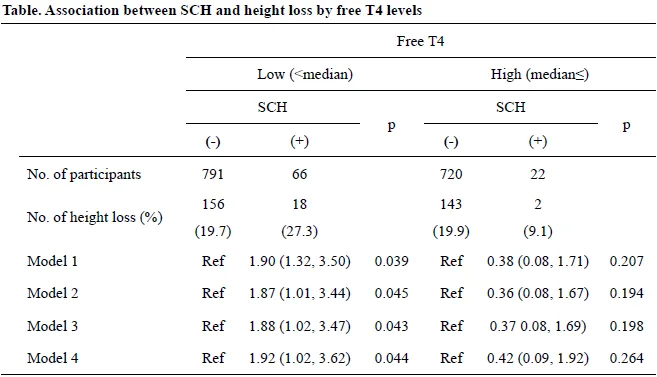
SCH; subclinical hypothyroidism, Ref; reference, T4; thyroxine. Model 1: Adjusted only for sex and age. Model 2: Adjusted for sex, age, and free triiodothyronine (T3). Model 3: Factors adjusted for Model 2 plus atherosclerosis. Model 4: Adjusted for sex, age, hypertension, high BMI, higher HbA1c, high HbA1c, daily drinking, current smoking, and low HDL-cholesterol. Median values of free T4 were 1.3ng/mL for men and 1.2 ng/mL for women.
Background: Subclinical hypothyroidism (SCH) has been reported to be associated with lower endothelial progenitor (CD34-positive) cell count, whereas an inverse association between circulating CD34-positive cell count and height loss is documented. Reports indicate height loss to be associated with all-cause mortality, and a higher CD34-positive cell count has been shown to predict longer life. Therefore, evaluating the association between SCH and height loss provides mechanistic insights underlying the association between height loss and mortality risk.
Methods: A prospective study involving 1,599 participants with normal free triiodothyronine (T3) and free thyroxine (T4) levels was conducted to determine the association between SCH and height loss.
Since the free T4 level influences the supply of active thyroid hormone (free T3), the analysis was stratified by the median free T4 level. Height loss was defined as the highest quintile of annual height decrease.
Results: SCH was positively associated with height loss in participants with low-normal free T4 levels (below the median), but not in those with high-normal free T4 levels (at or above the median). After adjusting for sex, age, free T3 level, atherosclerosis, and known cardiovascular risk factors, the adjusted odds ratios (95% confidence interval) for height loss were 1.88 (1.02, 3.47) and 1.92 (1.02, 3.62) in the low-normal free T4 group. The corresponding values in the high-normal free T4 group were 0.37 (0.08, 1.69) and 0.43 (0.09, 1.97).
Conclusion: SCH could influence height loss, and free T4 might influence the association between SCH and height loss in euthyroid individuals. These results clarify the mechanisms underlying the association between height loss and mortality risk.
Journal: Environmental Health and Preventive Medicine
Volume & Pages: vol.30 pp. 100
Title: Subclinical hypothyroidism and height loss according to free thyroxine levels: a prospective study
Authors: Yuji Shimizu, Nagisa Sasaki, Yuko Noguchi, Mutsumi Matsuu-Matsuyama, Shin-Ya Kawashiri, Hirotomo Yamanashi, Kazuhiko Arima, Seiko Nakamichi, Yasuhiro Nagata, Takahiro Maeda, Naomi Hayashida
Publication Date: December 15, 2025
DOI: https://doi.org/10.1265/ehpm.25-00362
For more details, please refer to the full article published in Environmental Health and Preventive Medicine.


