
Seasonal migration across the north-western Pacific and Indian Oceans in Swinhoe’s Storm-petrel Hydrobates monorhis
A joint research group led by Professor Noriyuki M. Yamaguchi of the Graduate School of Integrated Science and Technology and Curator Toru Nakahara of the Kitakyushu Museum of Natural History & Human History has, for the first time worldwide, clarified the migration route of a threatened sea bird, Swinhoe’s Storm-petrel Hydrobates monorhis, which breeds on Koyajima (Koyashima) Island. Koyajima is one of the component assets of the World Heritage site “Sacred Island of Okinoshima and Associated Sites in the Munakata Region.” This finding has been published online in the international academic journal Bird Conservation International.
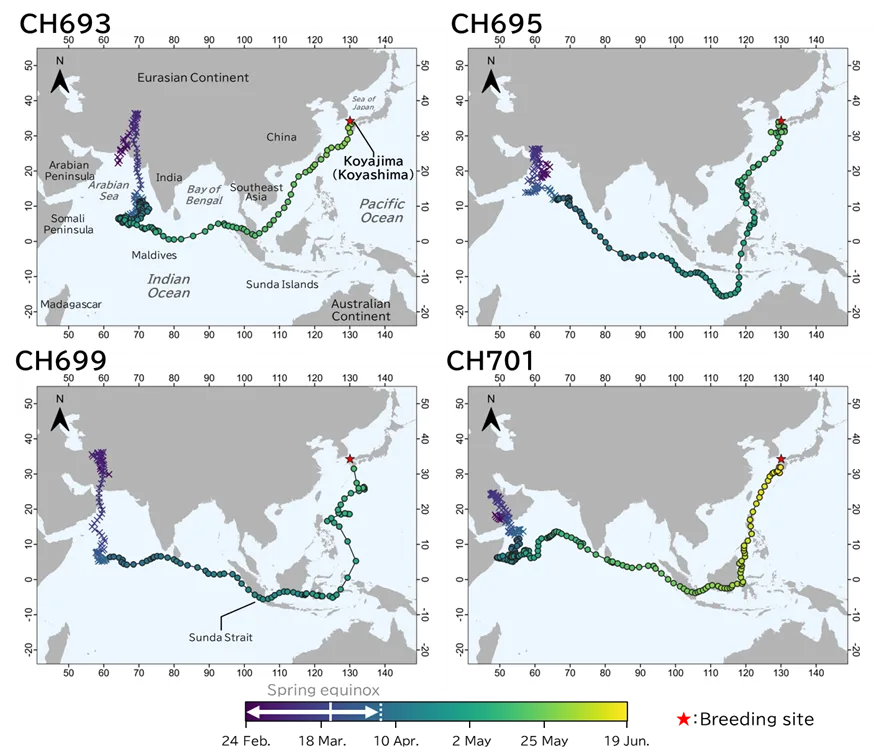
Estimated spring migration routes of four Swinhoe’s Storm-petrels. Crosses indicate locations estimated around the vernal equinox, when the reliability of latitude estimates is extremely low. CH693, CH695, CH699, and CH701 are the IDs of the tracked individuals.
Seabirds are experiencing a decline in their populations because of climate change and human activities. Understanding their spatiotemporal dynamics is crucial for effective conservation, but the distribution and movement patterns of pelagic seabirds are not yet fully elucidated. In the present study, we investigated the seasonal movements and wintering areas of Swinhoe’s Storm-petrel Hydrobates monorhis, a Near Threatened species that breeds primarily on islands in the north-western Pacific. The data analyses of geolocators retrieved from four birds showed that Swinhoe’s Storm-petrels migrated across the north-western Pacific and Indian Oceans and wintered in the Arabian Sea. The distance between their breeding colony and the wintering area was approximately 6,700 km, and the tracking distance for a seasonal migration exceeded 12,000 km. The migration pathway was characterised by large-scale movements in both north–south and east–west directions in the Eurasian offshore regions, which previously had been inferred from direct observations at such areas but not empirically confirmed. Wintering areas in the Arabian Sea overlapped with regions where plankton blooms are triggered by the monsoon in winter, which may produce high marine productivity and support the wintering of Swinhoe’s Storm-petrels in this sea area.
Journal: Bird Conservation International(Vol. 35)
Title: Seasonal migration across the north-western Pacific and Indian Oceans in Swinhoeʼs Storm-petrel Hydrobates monorhis
Authors: Toru Nakahara, Hiroto Okabe, Kosuke Otsuki, Takayasu Charles Amano, Tatsuya Nozaki, Keiichi Otsui, and Noriyuki M. Yamaguchi
Corresponding author: Toru Nakahara
Publication Date: October 27, 2025
DOI: https://doi.org/10.1017/S095927092510021X
For more details, please see the full article published in Bird Conservation International.


